
Mark and replace
A queen is a year job, not a forever job.
Workers tend, forage, and defend. Drones mate and die. The queen lays the eggs and puts out the pheromones that keep the box a colony. The Basics of Queen Management in Beekeeping Operations is the UF/IFAS paper. This page is that paper. Swarm is the split. This is the bee who stays, or the bee you buy.
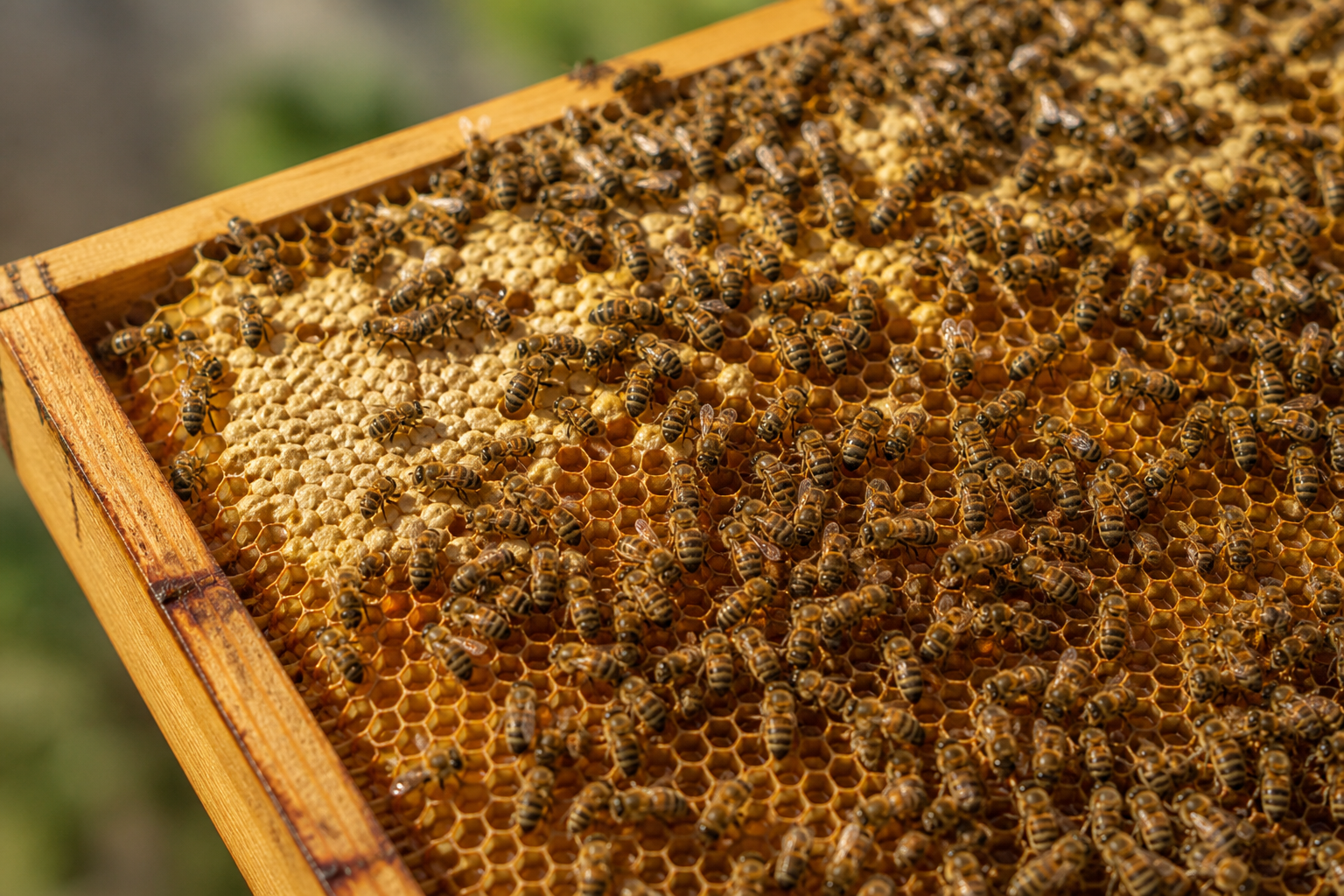
A healthy queen can lay up to 2,000 eggs daily. Productivity declines after one or two years.
What queen work actually names
She can live past seven years. The paper still wants some form of queen management, because the lay drops after one or two. Replace her annually if you are following this page. Late spring or early summer is when queens and drones are most available. A poor brood pattern is a mix of capped and uncapped cells. If unsealed brood is more than 20% of the frame, that is the indication Lee and colleagues named in the paper's citation, and the figure on The Basics of Queen Management in Beekeeping Operations.
Queen cells in the brood nest are not decoration. Overcrowding makes swarm cells so the box can split. A failing queen, with less pheromone, makes supersedure cells. Thick-capped drone cells scattered through worker brood can mean she is running out of stored sperm. The paper's Figure 5 is that frame. Letting the colony raise its own queen can take weeks and can fail. Buying a mated queen from a reputable breeder is the alternative The Basics of Queen Management in Beekeeping Operations names.
Florida is not a free-for-all on genetics. Chapter 5B-54 is the rule the paper cites. Queens here must come from a producer inspected and certified as producing queens without African ancestry. If you suspect an Africanized queen, replace her with a queen of known pedigree. AHB is the look-alike page. Race is not a comb guess.
A white mark in 2026, then watch the frame
The international year code on this paper is white for years ending in 1 or 6, yellow 2 or 7, red 3 or 8, green 4 or 9, blue 5 or 0. Find her. She is often a different color, larger, and shinier than the workers. A cage or queen catcher isolates her. A confident keeper can lift her by the wings. A queen catcher isolates her on the comb when fingers are a bad plan in a hot August box. Get this. The paper names a non-toxic queen marking pen. Many US keepers use a broad-tipped Posca PC-7M. Test the pen on something else first. Brush the thorax. Let it dry a few minutes. Release her on a frame and watch. If the workers go defensive, cage her for several hours and try again. The mark if 2026 is still an unmarked white year in that box.Get this.
Clipping is not swarm control. Cut half of one large front wing, the forewing, with small scissors while you hold her. If she tries to leave in a swarm she cannot fly, and the cluster is often on the ground or in a low shrub where you can put it back. The paper is plain: this does not reduce the stimuli that make a colony swarm. swarming is the control paper.
What color is 2026?
White. The year ends in 6. The Basics of Queen Management in Beekeeping Operations Table 1.
Does a clipped wing keep them from wanting to leave?
No. It only makes the attempt easier to recover. Read swarm control for the stimuli.
Sources
- The Basics of Queen Management in Beekeeping Operations. Michelini, Rawn, and Jack. Mark, clip, requeen. Brood pattern. Florida stock.
- Swarm Control for Managed Beehives. Clipping a wing is recovery, not the control paper.
- Florida Administrative Code Chapter 5B-54. Pests of honeybees and unwanted races. The inspection rule The Basics of Queen Management in Beekeeping Operations cites.